M-PRINT Model 2.0

Production of dental models

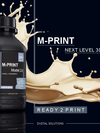
M-PRINT Model 2.0

Production of dental models

3D printing resin for the production of very precise, true-to-detail master, stump and / or functional models with finest and smooth surface structure

  • Without fillers and pigments
  • free from TPO
  • Ready 2 Print - No need to shake it up
  • Designed for tray-based photopolymerisation at 385 - 405 nm

Characteristics

  • Highly dimensionally stable, precisely grindable
  • Preparation lines are clearly visible thanks to the opacity
  • Maximum thermal stability
  • High strength and edge stability
  • Brilliant image sharpness
  • Now also optimised for LCD printers

Material properties

Property Value Test Method
Acrylate mixture
Viscosity 1250 ± 150 mPa·s ISO 3219 (23 °C, 5 - 100 s-1)
End product
Flexural strength 90 ± 5 MPa ISO 178
Modulus of elasticity 2150 ± 150 MPa ISO 178

3D Printers

M-PRINT 3D printing liquids are generally compatible with DLP printers operating at a wavelength of 385 nm and, to some extent, with LCD printers operating at 405 nm. Print parameters are available for the following printers:

rapidshape

  • D20+ 
  • D30+ 
  • D50+

The material parameters are pre-installed and/or available in the printer manufacturer's material library. (Visit rapidshape for more information.)

Asiga

  • Pico
  • MAX
  • PRO
  • PRO 4K
  • Ultra
  • Max 2

The material parameters are pre-installed and/or available in the printer manufacturer's material library. (Visit Asiga for more information.)

Straumann

  • PRO20
  • P30+
  • P50+

The material parameters are pre-installed and/or available in the printer manufacturer's material library.

SHERA

  • SHERAprint 20 pro
  • SHERAprint 30
  • SHERAprint 50

The material parameters are pre-installed and/or available in the printer manufacturer's material library.

DMG

  • DentaMile Desk RS-5
  • 3Delite

The material parameters are pre-installed and/or available in the printer manufacturer's material library.

Carima

  • IMD

Material parameters are pre-installed and/or can be found in the printer manufacturer’s material library. 

Anycubic

  • Photon Mono M7Pro

Recommendations for print parameters can be found in the downloads section of the relevant product page.

Elegoo

  • Saturn 3 ultra
  • Mars 4 ultra

Recommendations for print parameters can be found in the downloads section of the relevant product page.

Phrozen

  • 8K Mini

Recommendations for print parameters can be found in the downloads section of the relevant product page.

Applications

  • Models
  • Model stumps
  • Models for the thermoforming technique
  • Highly precise, highly detailed master, die and/or functional models with an extremely fine and smooth surface texture
Prozess step Time required (min)
1 Allow the design still in the printer after the printing process has been completed to drip off. 10
2 Remove construction platform, remove design and carefully cut off supports. 5
3 Clean the design in a closed container with cleaning fluid (propan-2-ol; isopropanol ≥ 99%), such as M-PRINT Wash, for 5 minutes in an ultrasonic bath. Note: Do not heat the design in the cleaning solution and do not leave it in the solution for a long period. 5
4 Use a pair of tweezers to remove the printed part from the cleaning fluid, blow it off with compressed air if necessary, and let it dry. Recommendation: Dry the design in an oven at 40 °C Note: Residues of the alcoholic cleaning fluid on the surface lead to a softer and sometimes scratch-sensitive surface after post-curing. 30
5 Post-curing of the design in the Otoflash G171 light curing device with 2 x 3500 flashes - turn the design between the two cycles. Recommendation: Use the nitrogen (protective gas) function, as this minimises oxygen inhibition and thus leads to improved surface and material properties. Observe the manufacturer's specifications for the device. 12
6 Manual post-processing, e.g. cleaning of the supports and polishing with commercially available rotating instruments for plastic processing. Note: To prevent inaccurate fitting after polymerisation, avoid excessive heat development during finishing and polishing. Depending on the design

Range

1,000 g bottle

Colour:

  • desert
  • shark-gray

Designed for the tray-based photopolymerisation at a wavelength of 385–405 nm