M-PRINT TryIn

Try-Ins

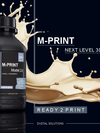
M-PRINT TryIn

Try-Ins

Light-curing, biocompatible 3D printing resin for the production of try-ins for the intraoral check-up of digitally designed dentures. 

  • Medical Device Class I - for try-in in the patient's mouth
  • Layer thicknesses 50 + 100 µm
  • Ready 2 Print - no shaking necessary
  • Designed for tray-based photopolymerization at 385 / 405 nm wavelength

Characteristics

  • Biocompatibility tested according to EN ISO 10993-1
  • TPO free
  • Free from fillers and pigments
  • Sedimentation-free
  • Fluorescent (ivory)
  • For realistic assessment of fit, phonetics and aesthetics prior to final construction
  • Suitable for checking bite registration and occlusion functionality
  • Available in the colors ivory and gum for monochrome try-ins or aesthetic bicolor
  • Odorless and tasteless
  • High precision - for excellent fit of denture base and arch
  • Tailored to the production of digital dentures with the Baltic Denture System

Material properties

Property Value Test method
Acrylate mixture
Viscosity 1200 ± 150 mPa·s ISO 3219 (23 °C, 5 - 100 s-1)
End product
Flexural strength 81 ± 5 MPa ISO 10477
Flexural strength 50 ± 2 MPa ISO 20795-1
Modulus of elasticity 1450 ± 100 MPa ISO 20795-1

M-PRINT 3D printing liquids are generally compatible with DLP printers with a preferred wavelength of 385 nm. Printing parameters or recommended printing parameters* are available for these printers.

rapidshape

  • D20+ 
  • D30+ 
  • D50+

Asiga

  • Pico
  • MAX
  • PRO
  • PRO 4K
  • Ultra
  • Max 2

Straumann

  • PRO20
  • P30+
  • P50+

SHERA

  • SHERAprint 20 pro
  • SHERAprint 30
  • SHERAprint 50

W2P

  • SolFlex 250 UHD

Nexa 3D

  • XiP

Carima

  • IMD

Elegoo

  • Saturn 3 ultra
  • Mars 4 ultra

Phrozen

  • 8K Mini

MiiCraft

  • Alpha 2K
  • Alpha 2.5K
  • Prime 110/150, Prime+
  • Hyper 50/80/125

*The user is responsible for the use of the product. Merz Dental assumes no liability and/or warranty for the use of non-system and/or untested components, nor for faulty results, as the manufacturer has no influence on the processing.

Applications

  • Try-in for removable full and partial dentures
  • Correction impression and bite registration
  • Wear period up to 30 days

Post processing

Process step Time required (min)
1 Allow the design in the printer after the printing process has been completed to drip off. 10
2 Remove construction platform, remove design and carefully cut off supports. 5
3 Clean the design in a closed container with cleaning fluid (propan-2-ol; isopropanol ≥ 99%), such as M-PRINT Wash, for 5 minutes in an ultrasonic bath. Note: Do not heat the design in the cleaning solution and do not leave it in the solution for a long period. 5
4 Use a pair of tweezers to remove the printed part from the cleaning fluid, blow it off with compressed air if necessary, and let it dry. Recommendation: Dry the design in an oven at 40 °C Note: Residues of the alcoholic cleaning fluid on the surface lead to a softer and sometimes scratch-sensitive surface after post-curing. 30
5 Only perform this post-curing step if a monoblock was printed without subsequent bonding or if bonding is to be performed using Weropress® – otherwise skip this step. Post-curing of the design in the Otoflash G171 light curing device with 2 x 3000 flashes - turn the design between the two cycles. Recommendation: Use the nitrogen (protective gas) function, as this minimises oxygen inhibition and thus leads to improved surface and material properties. 10

Range

500 g / 1,000 g bottle

Colour:

  • ivory
  • gum

Designed for the tray-based photopolymerization at 385 and 405 nm wavelength